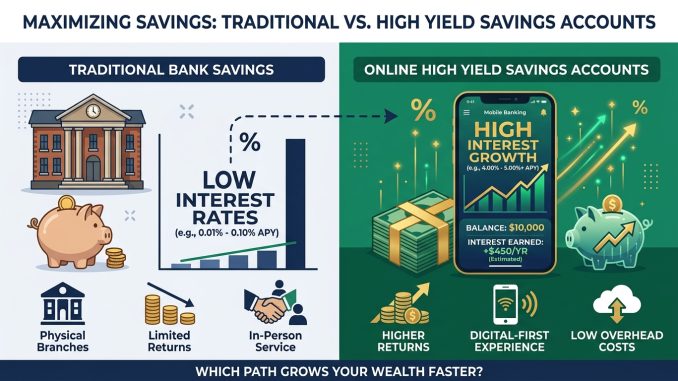
When managing personal finances, security and growth are top priorities. Many account holders keep their primary savings at traditional brick-and-mortar financial institutions out of habit or convenience. However, holding large cash reserves in standard accounts offering near-zero annual percentage yields (APY) can lead to significant opportunity costs over time due to inflation.
This article examines the structural differences between traditional savings accounts and High-Yield Savings Accounts (HYSAs), analyzing yield calculations, safety standards, and practical cash-management strategies to optimize liquid savings.
Understanding the APY Gap: Traditional vs. High-Yield Accounts
The fundamental distinction between traditional savings accounts and high-yield savings accounts lies in the interest rate offered to depositors.
According to historical data from national bank averages, traditional savings accounts at large national institutions typically offer baseline interest rates around 0.01% to 0.05% APY. In contrast, online-first banks and fintech platforms often offer competitive APYs ranging from 4.00% to 5.00% or more, depending on broader macroeconomic benchmark rates set by central banking systems.
A 5-Year Mathematical Breakdown
To understand how interest rate disparities impact total asset accumulation, consider a hypothetical deposit of $10,000 held over a five-year period with no additional monthly contributions:
Note: Calculations reflect monthly compounding interest. Actual future earnings depend on variable interest rate fluctuations.
Why Do Online Banks Offer Higher Interest Rates?
The ability of high-yield savings providers to offer significantly higher yields comes down to overhead costs and operational business models:
-
Reduced Overhead Costs: Online banks operate without physical branch networks, avoiding expensive commercial real estate leases, utility expenses, and localized branch staffing costs.
-
Customer Acquisition Strategy: Digital banks use competitive APYs as their primary mechanism to attract new depositors in a crowded financial technology market.
-
Efficiency of Scaled Technology: Modern cloud banking infrastructure allows online institutions to process transactions and maintain balances at a lower cost per user.
Safety and Security: FDIC and NCUA Coverage Explained
A common concern among consumers transitioning to online high-yield accounts is account safety.
Whether operating via a traditional branch network or an online interface, reputable U.S. financial institutions are backed by federal deposit insurance:
-
FDIC Insurance: The Federal Deposit Insurance Corporation (FDIC) is an independent agency of the U.S. government that protects funds held in insured banks up to $250,000 per depositor, per insured bank, for each account ownership category.
-
NCUA Insurance: The National Credit Union Administration (NCUA) provides equivalent coverage up to $250,000 for funds deposited in federally insured credit unions.
When selecting an HYSA, verifying that the institution is an FDIC member (or backed by an FDIC-insured partner bank) ensures your principal balance receives the exact same federal protections as funds stored in a legacy bank.
Key Factors to Evaluate Before Opening an HYSA
Before moving emergency reserves or short-term savings into a high-yield savings account, review the following account features to ensure alignment with your personal cash flow requirements:
-
Variable Rate Terms: APY rates on savings accounts are variable, meaning they fluctuate in response to economic policy shifts and central bank benchmark rate adjustments.
-
Transfer Lead Times: Because online banks are often separate from your daily checking account provider, standard Electronic Funds Transfers (ACH transfers) may take 1 to 3 business days to clear.
-
Withdrawal Guidelines: Review any monthly transaction limits or fee schedules associated with excess withdrawals.
-
Minimum Balance Requirements: Confirm whether maintaining the advertised APY requires a minimum opening deposit or daily minimum balance.
Conclusion: Balancing Convenience and Growth
While traditional bank accounts remain useful for everyday checking, bill payments, and immediate cash access via physical ATMs, keeping emergency reserves in a low-yield environment causes real purchasing power to decline over time. By allocating long-term liquid savings to a secure, FDIC-insured high-yield account, account holders can preserve capital while earning a competitive return.
Leave a Reply